
Velenje mining method
One of the world’s thickest lignite seams was instrumental for the development of innovative and highly productive mining methods. The coal seam situated beneath the Šalek Valley at depths ranging from 200 to 500 metres, is 8.3 kilometres long and 2.5 kilometres wide. The seam has an average thickness of 60 metres, with a maximum thickness of 170 metres. Coal mining at the Velenje Coal Mine has continued uninterrupted for more than 150 years, during which several mining methods have been trialled.
In the second half of the twentieth century, the longwall mining method gained acceptance and, owing to its distinctive characteristics and high productivity, became recognised worldwide. As an independent concept, the Velenje mining method is also cited in international technical literature on mining. In technological and organisational terms, the method continues to develop and improve, primarily aimed at increasing production per coal face, achieving better seam utilisation, enhancing employee safety, humanising work and improving economic efficiency.
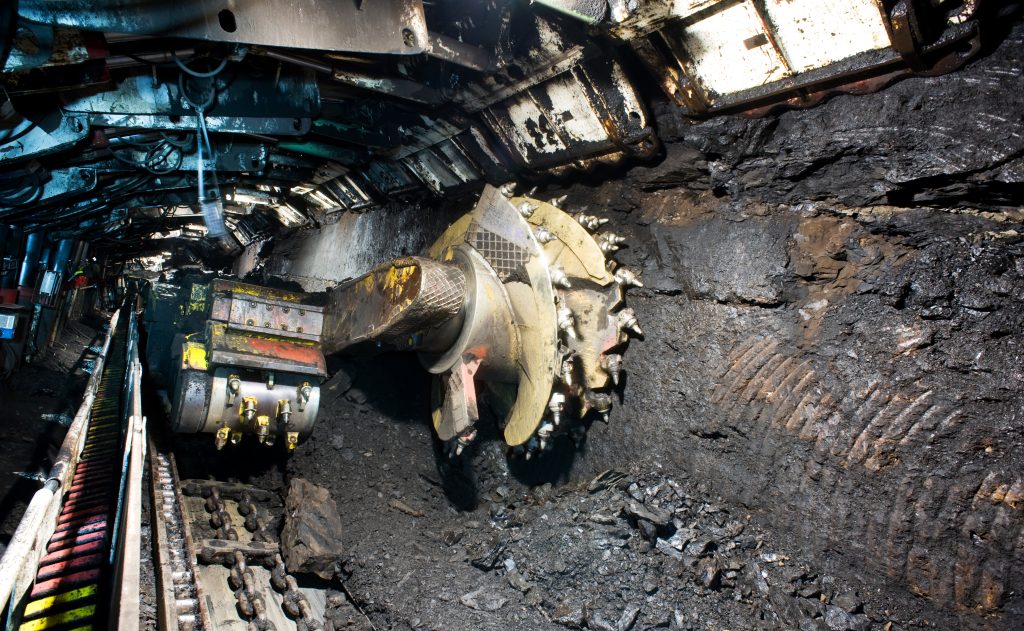
Historically, the Velenje mining method developed in two variants, namely: horizontal extraction of the bottom slice and intensive vertical extraction of the top-coal. According to this method, the extraction is vertically divided into an undercut and an overcut portion (bottom slice and top-coal section). The undercut portion extends to a height of 3–5 metres and is secured by hydraulic support, which enables mechanised extraction using excavators, such as roadheaders. Haulage is carried out by high-capacity chain conveyors. The overcut portion reaches a height of 7–17 metres and is subject to dynamic underground pressures that cause the coal seam to collapse. The coal is then released in a controlled manner onto the armoured face conveyor and transported away as it is produced.
The extraction of coal from the overcut portion proceeds in stages once a sufficient number of cuts and advances have been made in the undercut portion. With the existing equipment, this corresponds to 1–2 cuts in hard, tenacious coal and 2–3 cuts in fractured, friable coal. The controlled extraction of crushed coal from the overcut portion is achieved by lowering the coal over articulated roof supports at the front of the undercut portion. The selection of the mining method and the step width depend on the dimensions of the mining equipment and on the geomechanical properties of the coal, and are determined in accordance with established principles for designing methods of extraction of mining panels, on the basis of verified expert documentation set out in the Act ‘Criteria for the Safe Extraction of Coal beneath Water-Bearing Strata in Velenje Lignite Mines’.

Equipment development proceeded in accordance with technological progress. The electromechanical equipment of a modern coal face is of explosion-proof construction and comprises a hydraulic support section, an armoured face conveyor with either a standard or a side discharge, an electronically controlled extraction machine, and a directional conveyor with a crusher.
In November 2007, the Velenje Coal Mine received the Chamber of Engineers of Slovenia’s Award for Innovation for the Velenje mining method, in recognition of an innovative approach to engineering practice.
The principal parameters of the mining technology are:
- coal face width: up to 200 metres
- coal face length: up to 800 m
- mining height: 5–20 m
- extraction progress: 3 metres per day (occasionally exceeding 9 metres per day)
- daily extraction at a coal face: 8,000 tonnes per day (and in certain cases exceeding 16,000 tonnes per day)
- Productivity: up to 2,500 t/m/day
- Face productivity/efficiency: more than 130 tonnes per day
- Annual extraction: 2 million tonnes per annum (a maximum of 5.1 million tonnes in 1985)